Arrest and Trial
Jesus, retired from the late evening Last Supper to Gethsemane, asked his sleepy disciples to tarry with him, suffered incomprehensible pain and sorrow as He atoned for the sins of the world, was ministered to by an angel, and was finally betrayed by Judas in the early morning - likely around 2am to 3am (Mark 14:37, 14:41). This ordeal in the garden likely lasted for 3 or 4 hours.
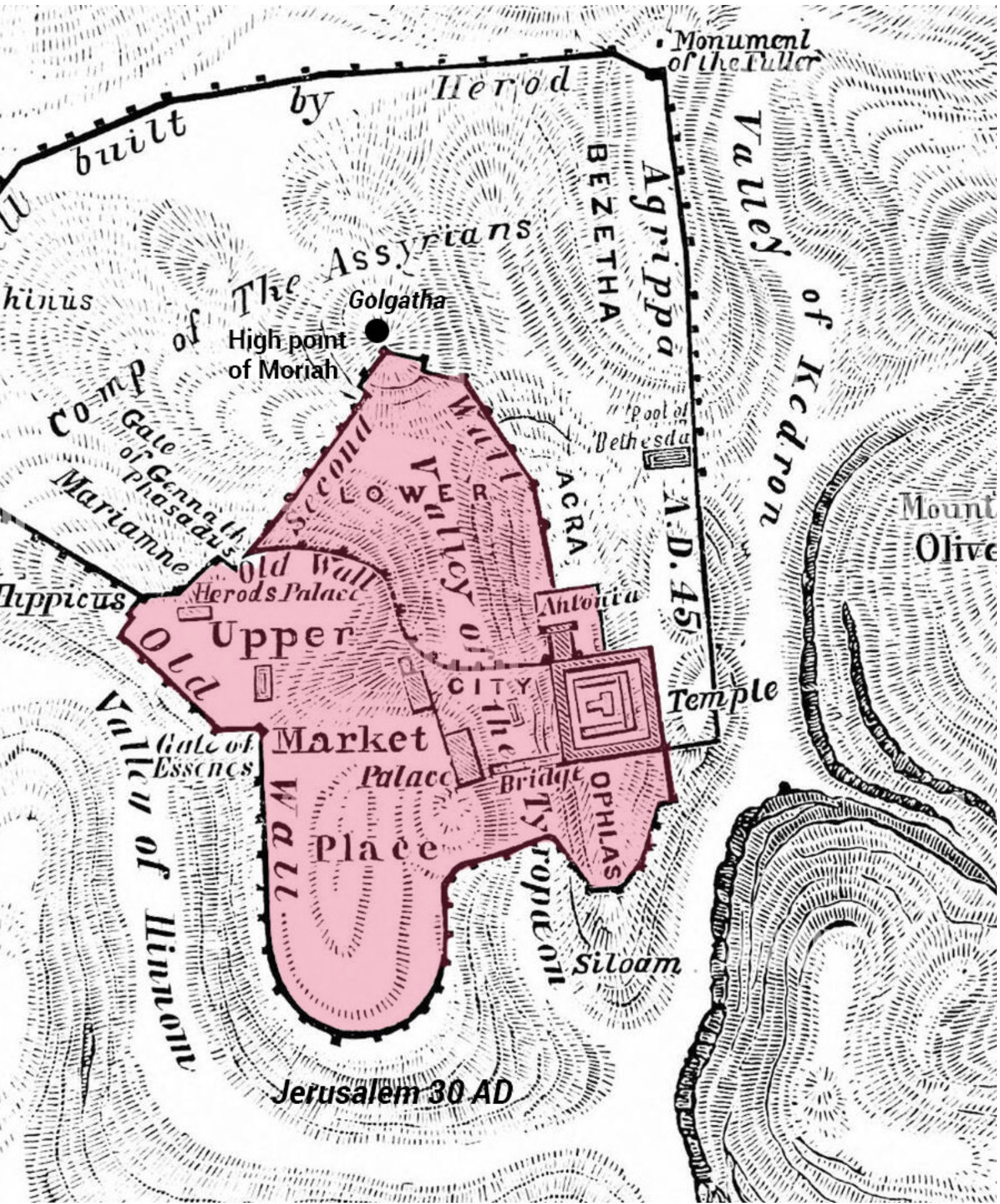
After his betrayal, he was taken by the Romans and chief officers of the Jews first to the house of Annas, then to Caiaphas, then to Pilate, then to Herod Antipas, then back to Pilate, then mistreated by the Roman soldiers and led to Golgotha where He was crucified at 9am (Mark 16:25). All of this happened in the space of about six hours.
Some have questioned whether there would be time for all of this questioning and travel. Annas and Caiaphas either occupied separate apartments in one building or had separate houses that shared one courtyard (John 18:12-27; Mark 14:53-72; Luke 22:54-71). Both would be just across the Kidron valley and into the city - about a 15 to 20 minute walk from Gethsemane.
Luke mentions 1 hour at the Annas/Caiaphas location (22:59) as only part of the time spent there. The Sanhedrin gathered at Caiaphas' house (Mark 14:53) and met formally to try Jesus "when day came" (Luke 22:66) "early in the morning" (Mark 15:1).
The palace of Herod Antipas was a 4 minute walk from the Temple adjacent to which was Annas/Caiaphas courtyard. The palace is called "Herod's palace" because Herod the Great, the father of Herod Antipas, commissioned its construction. The Gospels call it "the governor's palace" and the governor was Pilate. The governor lived in Caesarea on the coast, the capital of the Roman province of Judaea, but when he was in Jerusalem he resided at Herod's Palace (Josephus, Antiquities), which served as the praetorium or governor's palace after Judaea came under direct Roman rule in 6 AD. Thus, Herod Antipas and Pilate were effectively the same location.
The questioning of Jesus by Pilate could fit into half an hour, and by Herod less. During this time of questioning, the chief priests asked Jesus many questions, but Jesus answered them nothing (Mark 15:3). Herod questioned him in many words; but he answered him nothing (Luke 23:8-11). Even Pilate marveled greatly that Jesus answered him never a word (Matthew 27:13-14). This silence is reminiscent of Isaiah, "He was oppressed and He was afflicted, Yet He opened not His mouth; He was led as a lamb to the slaughter, And as a sheep before its shearers is silent, So He opened not His mouth." (Isaiah 53:7)
This Lamb of God was approaching a divinely appointed time to fulfill his mission. It was only in the final questioning by Pilate that Jesus did reaffirm His divine mission. Finally, Jesus was crucified outside the city walls, outside the northern wall of the city - about a 10 minute walk from Herod's palace. The crucifixion started at 9am on Nisan 14.
Timeline for the Trial
| Time | Event |
|---|---|
| 7pm | 14th of Nisan begins just before this at sunset; Last Supper |
| 11pm - 3am | Garden of Gethsemane |
| 3am - 8am | Betrayal by Judas, taken to Annas, then to Caiaphas, then to Pilate, then to Herod Antipas, then back to Pilate |
| 9am | Crucifixion started |
Candles and Torches
Who were these people crying, "crucify him"? What happened to the throngs of people who, just four days earlier on the Great Sabbath had cried Hosana and recognized Jesus as their messiah?
During the night of the 14th, according to tradition, Jewish families would have just finished searching the house by candlelight to purge their homes of leaven in preparation for Passover. As that candlelight search to remove the corruption of leaven concluded, a torchlight search to enshrine the corruption of the Chief Priests is begun. Paul brings the two together, "Purge out therefore the old leaven... for even Christ our passover is sacrificed for us" (1 Cor 5:7-8).
History is sprinkled with record of those who were willing to bear false witness in the dead of night. The night of Jesus' arrest is a clear example. The people at the judgement hall in the dark of night and early into the morning were not festival travelers nor did they likely comprise the body of family-oriented devout observers of the Passover preparation. They were there with a purpose, and that is to cry "crucify him" at the right time. They did not care about pretended Blasphemy, they cared about their popularity.
Blessing of the Sun
If you look up Birkat HaChama, you will find this information: "Birkat Hachama (Hebrew: 'Blessing of the Sun') refers to a rare Jewish blessing that is recited to the Creator, thanking God for creating the sun. The blessing is recited when the Sun completes its cycle every 28 years on a Tuesday at sundown. Jewish tradition says that when the Sun completes this cycle, it has returned to its position when the world was created. Because the blessing needs to be said when the Sun is visible, the blessing is postponed to the following day, on Wednesday morning."
We do not know for certain if the Wednesday of the crucifixion was one of these Wednesdays. Given the amount of uncertainty of the exact number of years from when this cycle started, nobody can know. It is an interesting thought anyway. In foretelling of his impending separation from his disciples, Jesus said, "Yet a little while is the light with you. Walk while ye have the light" (John 12:35).
There is something to be understood in the juxtaposition of light and dark in these events. Jesus is the light of the world. The creation account speaks of the light being separated from the darkness three days before the Sun was put into place. Just when the sun rose and Israel recited a prayer of gratitude for the creation of the sun, Jesus would be lifted up and the sun would be darkened.
The Lamb of God
At the exact time Pilate concluded his examination of Jesus and pronounced, "I find no fault in this man", Jewish families would be concluding their inspection of the selected Passover lamb to verify there were no blemishes.
Mark says the crucifixion started at 9am (the third hour of the day). Matthew, Mark, and Luke all say there was darkness over the land between the sixth and ninth hours (noon to 3pm). Why does John say that Jesus was in front of Pilate being judged at the sixth hour if that is when Jesus was on the cross and when there was darkness? (John 19:14-15)
The answer lies in a translation issue and in why John said it the way that he did. Most translations, such as the KJV read, "and about the sixth hour: and he saith unto the Jews, Behold your King". The Young's Literal Translation (YL T), which prioritizes accuracy over readability says, "and as it were the sixth hour, and he saith to the Jews, 'Lo, your king!'"
Why would John be saying that Pilate delivering Jesus to be crucified was LIKE the sixth hour? What was he trying to say? The sixth hour (noon) was when the selection of the Passover lamb was finalized. By saying, "as it were the sixth hour", John is telling us that when Pilate delivered Jesus to be crucified, he completed the selection of the paschal lamb in preparation for the Passover. So at that moment begins the fulfillment of John the Baptist's prophetic greeting, "Behold, the Lamb of God!"
We are told there was darkness over the land for the space of three hours, from noon to 3pm. We are also told that sometime after that, Jesus cried again with a loud voice and yielded up the ghost. At the same time the earth quaked and the veil of the temple was ripped open. A Roman centurion watching this happen feared greatly and testified, "truly this was the Son of God" while the people smote their chests. The Persic version reads, "they went back, and kneeled down, and prostrated themselves to the ground"; as being in the utmost astonishment, confusion, fear, and dread: and returned; to the city, and to their own houses, where they might more seriously, and with the greater composure of mind, reflect on these things.
Is there a lesson in the darkness? Is there a reason for it to be for three hours? These events serve as signs for those familiar with prophecy. For example, Amos wrote, "And it shall come to pass in that day, saith the Lord God, that I will cause the sun to go down at noon, and I will darken the earth in the clear day: And I will turn your feasts into mourning." (Amos 8:9-10)
The Lamb was not allowed to be sacrificed after sunset, or in darkness. In a way, causing darkness to cover the land at noon was God indicating that the day is past and on a day in Jerusalem when 250,000 lambs were to be slaughtered, it is a statement that the system of animal sacrifice is over.
Similarly, the veil of the temple, through which the High Priest passed once each year, was rent in twain top to bottom. "They all must have understood that it meant that God's Own Hand had rent the Veil and forever deserted and thrown open that Most Holy Place where He had so long dwelt." (Edersheim 2:611-12.)
In other words, the Law is fulfilled, salvation comes not by the law of Moses anymore, but through Jesus Christ; exactly the message that Paul took to the Jews thereafter.
Timeline for the Crucifixion
| Time | Event |
|---|---|
| 8am | The chosen Lamb has no blemishes. "I find no fault in this man" |
| 9am | Crucifixion begins |
| 12pm | Darkness covers the land |
| 3pm | Three hours of darkness ends |
| 3pm - 5pm | Passover lambs are slain, Jesus gives up the ghost, "It is finished", blood of the lambs is splashed on the north side of the altar, blood of Jesus' pierced side is splashed on the north side of the city |
| Before 6pm | Jesus' body taken down and readied for burial |
North of the City, North of the Altar
Imagine the many people, in and around Jerusalem to celebrate the Passover. On the one day of the year when the common Israelite could approach the great altar, they, along with their unblemished lamb, may have passed along on the north side of the city on their way to the temple and passed right by the very Passover being offered for the redemption of humanity - completely missing the lesson. As they splashed the blood of their lamb on the north side of the altar at the temple, Jesus' blood, released from the soldier's piercing spear, splashed on the north side of the city.
There is a reason why Abraham journeyed to Mount Moriah to offer his firstborn son in fulfillment God's command. There is a reason it had to be Moriah; Moriah and the temple mount are one and the same. 1000 years later, the city of David would be located there. The temple was built on that mount, but not at the highest point. The highest elevation of Mount Moriah is just outside the northern wall of the city - right where Golgotha is described to be. If Abraham and Isaac ascended to the peak of Moriah (why would he not?), the location of the altar he built, and the replacement sacrifice miraculously provided by God would have been the same location as the crucifixion site.
Speaking of very precise symbolism, Jehovah was specific when he commanded the Israelites to slaughter the sacrifice on the north side of the alter (Leviticus 1:11). Why? It points to this exact time and place on the north side of the city.
As the light of day returned, Israel would be required to make a weighty decision - accept the literal fulfillment of the law in Christ or continue as before. We know many went away in deep thought, reflection, and even great remorse as they witnessed the events of the day unfold.